

Is Net Zero Achievable?
In June 2019 the UK passed a new legislation to reduce its emissions by 100% relative to 1990 levels by 2050. This is a bigger commitment than the previous Climate Change Act 2008, which promised 80% reduction of emissions of 1990 levels by 2050. The question is; can we achieve it?
What does Net-Zero mean?
It is to achieve a balance between the amount of greenhouse emissions produced and the amount removed from the atmosphere. The are 6 major greenhouse gases; carbon dioxide (makes up the bulk of greenhouse gas emissions), methane, nitrous oxide, hydrofluorocarbons, perfluorocarbons, sulphur hexafluoride. Expecting to completely cut emissions of these gases is not realistic but instead the plan is to offset the emissions. Greenhouse gases are absorbed by the oceans and forests naturally, so any emissions we produce should not exceed what they can absorb.
What does it require?
The UK has been gradually reducing its greenhouse emissions for the last 30 years, even though globally they have been increasing. However the rate of reduction has not so far been enough to expect to meet the target of net zero by 2050. There are several big challenges to be met and none of them are simple but essentially the 3 things that need to happen are electrification,increased harvesting and dependence on renewable energy and cleaner fossil fuels.
What are the main challenges?
One of the biggest challenges is industry which contributes 42% of direct CO2 energy-related and process emissions. Some sectors of industry such as steel, cement and chemical production are known as “hard-to-abate” because they are not easily electrified or because they use fossil fuels as raw materials.
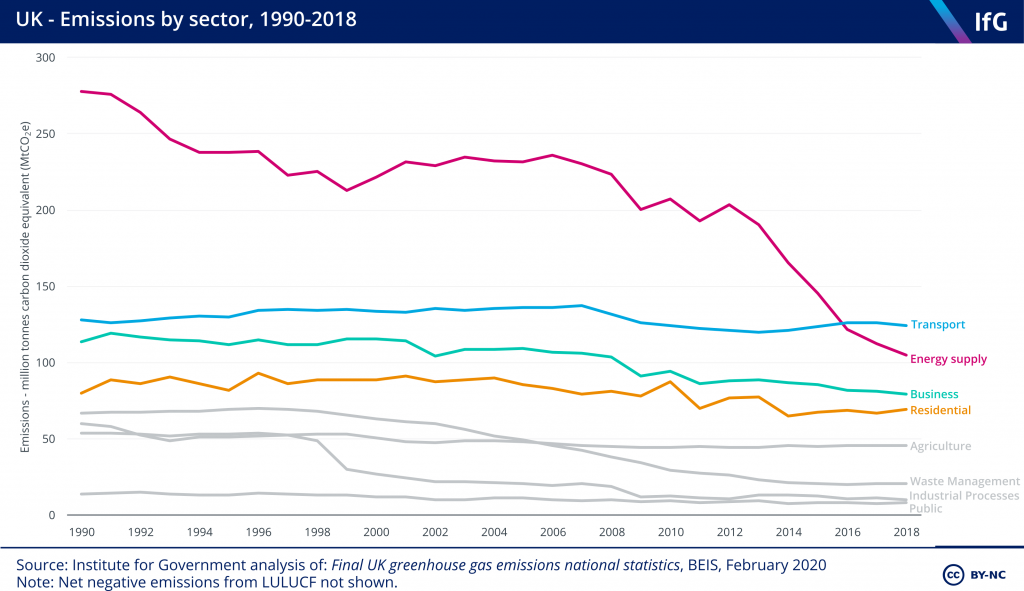
While industry is a challenge the highest emissions come from 4 other sectors; transportation, energy supply, business (commercial use of electricity) and residential. All together they account for 78% of current emissions. The UK has achieved significant reduction in emissions in the energy supply sector, particularly in the last 8 years since the phasing out of coal and replacing it with renewable energies such as wind and solar. However little has changed in the other sectors of transport and homes.
What are the solutions?
There needs to be a significant acceleration in innovation of clean energy to make net zero by 2050 achievable. Almost 90% of electricity produced globally will need to come from renewable sources by 2050, with solar and wind to make up 70%.
There are already technologies available to decarbonise emissions but further development is still required and there is a need for scaling up to make them more economically viable. Technology alone cannot deliver net zero emissions, there needs to be support from policy makers to create incentives to create the demand for low-carbon and zero-carbon products.
The technologies to largely decarbonize these sectors do exist, but they are at various stages of development. Technology on its own cannot deliver net-zero emissions. Support from policy-makers and incentives to generate demand for low-carbon or zero-carbon products will also be required. Public support and demand for low-carbon products will be required to create real change.
In Conclusion
Is net zero achievable, yes it is. As discussed there are big hurdles to overcome and some challenging milestones to meet but with culture change to get the public behind the targets and encouraging a demand for zero-carbon and low-carbon products then industry and people will be working for a common goal.